How to Choose the Right AED for Your Business | SPARK CPR
How to Choose the Right AED for Your Business or Organization
Deciding that your business, school, church, gym, or organization needs an AED is an important first step.
Then comes another question:
Which AED should you buy?
A quick search can leave you comparing multiple manufacturers, different prices, fully automatic and semi-automatic models, CPR feedback systems, Wi-Fi connectivity, pediatric capabilities, replacement pads, batteries, warranties, and accessories.
At first glance, many AEDs seem to do essentially the same thing.
But there are meaningful differences.
The right AED for a small office may not be the same device you would choose for a school, manufacturing facility, athletic complex, church, or large multi-building organization.
The goal shouldn't simply be to purchase an AED.
The goal is to choose an AED that your organization can confidently use, properly maintain, and keep ready for an emergency for years to come.
Here's what to consider before buying.
What Does an AED Actually Do?
An automated external defibrillator, or AED, is a computerized medical device designed to analyze a person's heart rhythm during cardiac arrest and determine whether a defibrillation shock is appropriate.
The device provides instructions to the rescuer and will only advise or deliver a shock when its analysis determines that a shockable rhythm is present.
The FDA divides AEDs broadly into public-access AEDs and professional-use devices. Public-access AEDs are specifically intended for use by lay rescuers with minimal training and are commonly found in schools, offices, airports, community centers, and other public locations.
That's important for business owners.
You aren't buying a piece of equipment that requires someone to interpret a heart rhythm and decide whether the patient should receive a shock.
The AED makes that determination.
Your employees need to recognize the emergency, call 911, begin CPR, retrieve the AED, apply the pads, and follow its instructions.
Start With Your Organization, Not the AED
Before comparing brands, start by looking at your environment.
Ask:
Who will potentially use the AED?
Where will the AED be located?
How large is the facility?
Are children regularly onsite?
Is the environment loud?
Will the AED be indoors or exposed to harsher conditions?
How many AEDs will the organization manage?
Who will be responsible for maintenance?
How important is real-time CPR feedback?
Do you want remote monitoring or connectivity?
What will replacement pads and batteries cost over the life of the device?
These questions help narrow your options much more effectively than simply asking:
“Which AED is the best?”
There isn't one device that is automatically the right choice for every organization.
The better question is:
Which AED fits the way our organization will actually use and maintain it?
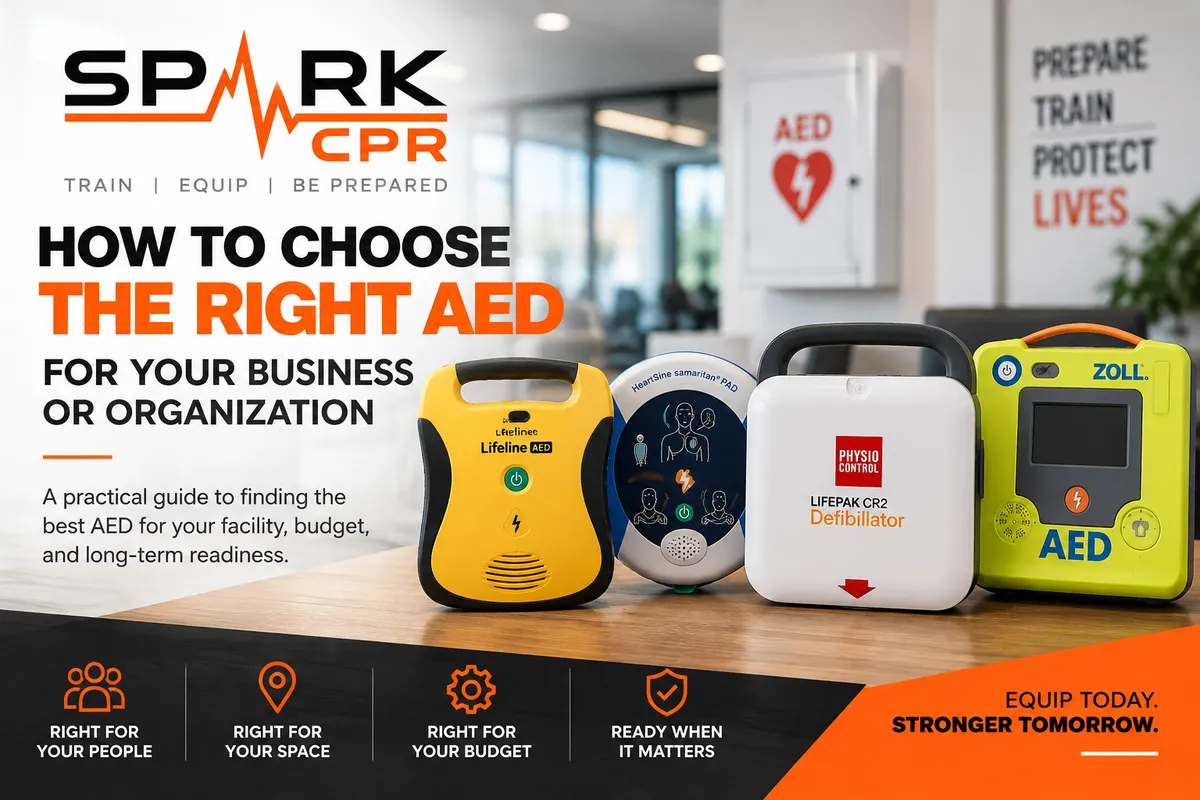
SPARK CPR currently offers AED options from manufacturers including Defibtech, HeartSine, LIFEPAK/Physio-Control, and ZOLL.
View AEDs available from SPARK CPR
1. Choose an FDA-Approved AED
The first consideration should be straightforward:
Purchase an AED that is approved for sale by the U.S. Food and Drug Administration.
The FDA regulates AEDs and their necessary accessories as medical devices. It maintains lists of approved AED systems and compatible accessories such as electrode pads and batteries. The agency also recommends purchasing necessary accessories from authorized retailers to help ensure they are approved and compatible with the device.
Compatibility matters.
AED pads and batteries are not universally interchangeable.
The replacement component must be designed and approved for the specific AED model.
That's one reason long-term product support should be considered when selecting an AED—not just the initial price of the device.
2. Decide Between Fully Automatic and Semi-Automatic
One of the first specifications you'll encounter is whether an AED is fully automatic or semi-automatic.
Both types analyze the patient's heart rhythm and determine whether a shock is appropriate.
The difference is how the shock is delivered.
Semi-Automatic AED
When a semi-automatic AED detects a shockable rhythm, the device instructs the rescuer to stand clear and press a flashing shock button.
The rescuer presses the button to deliver the shock.
Fully Automatic AED
A fully automatic AED analyzes the rhythm and, when a shock is required, warns rescuers to stand clear and then delivers the shock automatically.
The rescuer does not press a shock button.
The FDA recognizes both fully automatic and semi-automatic AED designs.
Neither design eliminates the need to follow the device's instructions.
The decision often comes down to organizational preference.
Some organizations like the traditional interaction of a semi-automatic device.
Others prefer eliminating the additional step of requiring a rescuer to press a shock button.
SPARK CPR currently carries both types, including semi-automatic and fully automatic options from HeartSine, LIFEPAK, ZOLL, and other manufacturers.
3. Consider How Much Guidance the Rescuer Will Need
Every modern public-access AED provides instructions.
But the type and amount of guidance can vary significantly.
Some devices primarily rely on voice prompts and simple visual indicators.
Others include:
Graphic instructions
Color displays
Full-motion video
CPR timers
Compression metronomes
CPR depth feedback
CPR rate feedback
Visual compression guidance
Think about the person most likely to use the AED.
If your organization has employees who regularly receive CPR training, straightforward voice prompts may be completely appropriate.
If the device may be used by someone who has never responded to an emergency, additional visual guidance or CPR feedback may provide extra confidence.
For example, the Defibtech Lifeline VIEW uses a full-color display with video instructions that demonstrate steps such as preparing the patient, applying pads, delivering a shock, and performing CPR.
The ZOLL AED 3 uses a color display and Real CPR Help technology to provide real-time feedback on CPR compression rate and depth.
Those features won't be necessary for every organization, but they are worth considering.
4. Decide Whether CPR Feedback Is Important to You
An AED does much more than deliver a shock.
CPR remains a critical part of cardiac arrest response.
That's why some AED manufacturers have incorporated technology designed to coach rescuers through chest compressions.
For example, ZOLL's Real CPR Help technology provides feedback on compression rate and depth. Depending on the device, rescuers can receive prompts such as “Push Harder” or confirmation that compressions are being performed appropriately.
The ZOLL AED 3 expands on this with a color display showing CPR information in real time.
The LIFEPAK CR2 uses CPR coaching technology and a metronome to guide responders through CPR, while certain CR2 configurations also use cprINSIGHT analysis technology to analyze the rhythm during chest compressions and reduce interruptions.
For organizations where lay rescuers may be nervous about performing CPR correctly, feedback technology can be an important consideration.
5. Consider Pediatric Use Before You Buy
If children regularly use your facility, pediatric capability should be discussed before purchasing the AED.
This is particularly important for:
Schools
Daycares
Churches
Youth sports organizations
Recreation centers
Community facilities
Family entertainment businesses
Different AEDs handle pediatric patients differently.
Some require separate pediatric electrode pads.
Others can switch between adult and pediatric modes while using the same electrode set.
For example, the LIFEPAK CR2 includes a Child Mode that reduces energy to pediatric levels without requiring the rescuer to change electrodes.
The ZOLL AED 3 also incorporates an integrated child mode using its CPR Uni-padz electrodes.
Other AEDs use dedicated pediatric electrode pads.
There isn't anything inherently wrong with either approach.
The important question is:
Will your organization have the correct pediatric equipment immediately available if the patient is a child?
For schools and youth organizations especially, pediatric planning shouldn't be an afterthought.
6. Look Beyond the Purchase Price
This is one of the biggest mistakes organizations make when comparing AEDs.
They compare only the price of the unit.
But owning an AED involves additional expenses over time.
Depending on the model, those may include:
Adult electrode pads
Pediatric electrode pads
Batteries
Combination pad-and-battery cartridges
Carrying cases
Cabinets
Replacement rescue accessories
Program-management services
Electrode pads expire.
Batteries eventually need replacement.
Some models have longer consumable life than others.
That means the AED with the lowest purchase price isn't necessarily the device with the lowest long-term cost of ownership.
For example, ZOLL states that the AED Plus uses pads and batteries with five-year lives under specified conditions.
Defibtech offers Lifeline battery options with manufacturer-listed standby lives of five or seven years depending on the battery configuration.
HeartSine uses its Pad-Pak system, which combines the battery and electrode pads into a replaceable cartridge system.
Before buying any AED, ask:
What will this device cost us to maintain over the next five to ten years?
SPARK CPR carries replacement AED electrode pads and AED batteries for the AED brands we support.
7. Evaluate Maintenance and Readiness Features
An AED does little good if it isn't ready during an emergency.
Modern AEDs perform internal self-checks, but someone within your organization should still be responsible for verifying device readiness and monitoring consumables.
Depending on the device, readiness may be communicated through:
Status lights
Check marks
Visual indicators
Audible alerts
Display messages
Remote monitoring notifications
The original Defibtech Lifeline, for example, performs automatic self-tests and provides visual and audible device-status indications.
More advanced connected AEDs can take this further.
The LIFEPAK CR2 can use connectivity and its AED management platform to remotely communicate readiness issues such as battery condition, electrode expiration, or failed self-tests.
The ZOLL AED 3 offers optional Wi-Fi connectivity that can be used for remote device-status monitoring.
Remote monitoring can become particularly valuable when an organization manages several devices across multiple locations.
For a small office with one AED, a simple manual inspection program may be perfectly manageable.
For a school district, business with multiple branches, or organization maintaining dozens of AEDs, connected management can become much more valuable.
8. Consider the Environment Where the AED Will Be Stored
Where will the AED actually live?
An office environment is very different from:
A factory
An outdoor athletic complex
A warehouse
A vehicle
A marina
A dusty industrial facility
A recreational setting
Environmental protection is commonly communicated through an IP rating, which describes resistance to dust and water intrusion.
For example, ZOLL lists the AED Plus with an IP55 rating, and Stryker identifies an IP55 rating for the LIFEPAK CR2.
Organizations operating in harsher environments should pay closer attention to durability specifications than a small climate-controlled office might.
Also remember that an AED shouldn't simply be placed outdoors without considering manufacturer-approved storage temperatures and environmental protection.
The environment should influence both the AED you purchase and how you store it.
9. Think About Size and Portability
Will the AED stay mounted inside a cabinet?
Or will employees carry it to athletic fields, job sites, events, vehicles, or remote areas?
A lightweight, compact device can be attractive for mobile applications.
HeartSine describes its samaritan PAD 350P and 360P units as compact public-access AEDs and offers both semi-automatic and fully automatic configurations.
For an AED that will remain permanently mounted in the same hallway, portability may be less important.
Again, the environment should drive the purchase.
10. Don't Forget the AED Cabinet and Signage
The AED itself is only part of the installation.
Once you purchase the device, people need to be able to find it.
A good AED location should be:
Visible
Accessible
Clearly marked
Available during operating hours
Known to employees
Located where retrieval time is minimized
An AED locked in a manager's office is much less useful than an accessible AED in a clearly identified location.
Wall-mounted cabinets can help establish a highly visible and consistent location.
Some cabinets also incorporate alarms that activate when the cabinet is opened.
View AED cabinets from SPARK CPR
Organizations should also consider AED signage, directional signs, and whether someone unfamiliar with the building could quickly identify the device.
11. Determine How Many AEDs You Actually Need
Purchasing the right model doesn't solve the problem if the AED is too far away.
Imagine a 150,000-square-foot manufacturing facility with a single AED located in the front office.
Technically, the organization owns an AED.
Practically, an employee at the opposite end of the facility may be several minutes away from it.
AED placement should be based on retrieval time, not simply building count.
The American Heart Association emphasizes rapid access to CPR and defibrillation as part of effective AED programs, while the FDA notes that defibrillation is time-sensitive.
Walk your facility.
Start at the proposed AED location.
Then walk to:
The farthest work area
The warehouse
The gym
The athletic field
The cafeteria
The second floor
The parking area
Any separate buildings
Ask:
Could someone retrieve the AED and return quickly during an actual emergency?
If the answer is no, your organization may need more than one device.
We'll cover this topic in greater detail in an upcoming SPARK CPR guide on determining how many AEDs a facility needs.
12. Decide Whether Connectivity Matters
Connected AEDs are becoming increasingly useful for organizations managing larger programs.
Depending on the AED and service configuration, connectivity can allow an organization to remotely monitor information such as:
AED readiness
Battery status
Pad expiration
Self-test results
Device location
Connectivity status
The LIFEPAK CR2 offers connected-device capabilities through Stryker's AED management systems, including readiness notifications and remote monitoring.
The ZOLL AED 3 also offers optional Wi-Fi connectivity and device-management capabilities.
For a single AED, those capabilities may not be necessary.
For an organization responsible for AEDs across numerous buildings, they can simplify program management considerably.
AED Models Currently Available Through SPARK CPR
Rather than selling only one type of AED, SPARK CPR offers several options because different organizations have different needs.
Defibtech Lifeline
The Defibtech Lifeline AED uses straightforward controls and extensive voice prompts. Defibtech describes the unit as having two primary controls—a power button and shock button—along with visual indicators and automatic self-tests.
This straightforward design may appeal to organizations looking for a traditional public-access AED without a large number of additional features.
Defibtech Lifeline VIEW
The Defibtech Lifeline VIEW adds full-motion color video instructions that visually walk the rescuer through the response.
That can be particularly helpful when visual guidance is a priority or when the AED may be used in a noisy environment.
HeartSine samaritan PAD 350P and 360P
The HeartSine line provides compact public-access AED options.
The HeartSine samaritan PAD 350P is semi-automatic, while the HeartSine samaritan PAD 360P is fully automatic. Stryker describes the line as compact and straightforward to operate.
LIFEPAK CR2
The LIFEPAK CR2 AED incorporates features such as CPR coaching, a Child Mode that uses the same electrodes for adult and pediatric response, and connected-device capabilities on compatible configurations.
For organizations interested in advanced program management or facilities serving both adults and children, those features are worth evaluating.
ZOLL AED Plus
The ZOLL AED Plus incorporates Real CPR Help technology, which provides real-time feedback designed to guide the rescuer's CPR compressions. ZOLL also lists five-year pads and batteries under specified conditions and an IP55 environmental rating.
ZOLL AED 3
The ZOLL AED 3 combines Real CPR Help with a color touchscreen, integrated pediatric mode, CPR Uni-padz, and optional Wi-Fi connectivity.
Those features can make it attractive to organizations looking for additional CPR coaching and device-management capabilities.
What Is the Best AED for a School?
Schools should pay particular attention to:
Pediatric capabilities
Ease of use
AED placement
Athletic facilities
Pad and battery maintenance
Staff training
The number of devices needed across campus
An integrated pediatric mode may simplify readiness because it can reduce the need to locate separate pediatric pads during an emergency, depending on the model.
Schools with multiple buildings may also benefit from connected AED management.
But the specific device should be selected only after evaluating the campus and the school's response plan.
What Is the Best AED for a Business?
For a typical office or small business, simplicity and long-term maintenance may be more important than advanced connectivity.
Consider:
Can an employee easily operate it?
Can we maintain it?
Can we afford its pads and batteries for the life of the device?
Can everyone find it quickly?
A straightforward AED that is properly maintained and accessible is far more useful than an expensive device hidden in a closet or allowed to expire.
What Is the Best AED for a Gym or Athletic Facility?
Fitness facilities and athletic organizations should consider:
Heavy public use
CPR feedback
Device durability
Visibility
Fast accessibility
Pediatric needs where youth sports are involved
Multiple AED locations for large facilities
Michigan also has specific AED requirements affecting certain qualifying health clubs, making proper AED planning particularly important for gym owners.
What Is the Best AED for a Church or Community Organization?
Churches and community organizations often have a wide age range present, from young children to older adults.
That makes pediatric capability and ease of use important considerations.
These facilities may also have volunteers rather than full-time safety personnel responding, making clear voice or visual instructions especially useful.
AED Buying Checklist
Before purchasing an AED, work through these questions:
Is the AED FDA approved?
Do we want fully automatic or semi-automatic operation?
How much voice and visual guidance do we want?
Do we want real-time CPR feedback?
Will we need pediatric capability?
Does the unit require separate pediatric pads?
How long do the pads last?
How long does the battery last?
What will replacement supplies cost?
How difficult is the device to maintain?
Do we need remote monitoring?
Will the AED be used in a harsh environment?
Do we need a cabinet or carrying case?
How many AEDs does our facility need?
Who will inspect the device and track expiration dates?
Are our employees trained to perform CPR and use an AED?
If you can answer those questions, choosing an AED becomes much easier.
Don't Choose an AED Based on Price Alone
Price matters.
But it shouldn't be the only factor.
The lowest-priced AED may require more expensive consumables.
A more expensive AED may include features your organization doesn't actually need.
Another unit may cost more initially but simplify pediatric response or long-term maintenance.
The correct comparison is not simply:
AED A costs less than AED B.
It is:
Which device gives our organization the right combination of usability, readiness, maintenance, features, and long-term cost?
That's a much better way to make the decision.
Training Should Be Part of the AED Purchase
AEDs are intentionally designed to guide a rescuer through an emergency.
But having employees who are comfortable with CPR and AED use improves overall preparedness.
During cardiac arrest, employees may need to:
Recognize that the patient is unresponsive
Call 911
Begin CPR
Send someone for the AED
Apply the pads
Follow the device prompts
Deliver or stand clear for a shock
Resume CPR
Continue until EMS takes over
That sequence is much easier to understand after employees have physically practiced it.
SPARK CPR provides American Heart Association CPR, AED, and First Aid training for businesses, schools, churches, and other organizations.
For groups, we can also bring onsite CPR and AED training directly to your facility.
Build an AED Program, Not Just an AED Purchase
Buying an AED should be the beginning of your program—not the end.
A complete AED program considers:
The Device
Is it appropriate for your organization?
The Location
Can someone retrieve it quickly?
The Maintenance
Are the pads, battery, and device ready?
The People
Does your staff know what to do?
The Plan
Who calls 911, performs CPR, retrieves the AED, and meets EMS?
Those pieces work together.
An AED sitting on a shelf doesn't create emergency preparedness by itself.
Let SPARK CPR Help You Choose the Right AED
There are a lot of AEDs on the market, and the differences aren't always obvious from a product page.
SPARK CPR is a firefighter-owned emergency preparedness and training company serving businesses, schools, churches, healthcare offices, athletic organizations, and other facilities throughout Southeast Michigan while providing AED equipment to organizations beyond our local training area.
We offer AEDs and AED accessories from manufacturers including Defibtech, HeartSine, LIFEPAK/Physio-Control, and ZOLL.
We can also help your organization think through factors such as:
Facility size
AED placement
Pediatric needs
Automatic versus semi-automatic operation
CPR feedback
Long-term maintenance
Pads and battery replacement
Cabinets and accessories
Employee CPR/AED training
The goal isn't to sell your organization the AED with the longest feature list.
It's to help you choose an AED that fits your organization and will be ready when someone needs it.