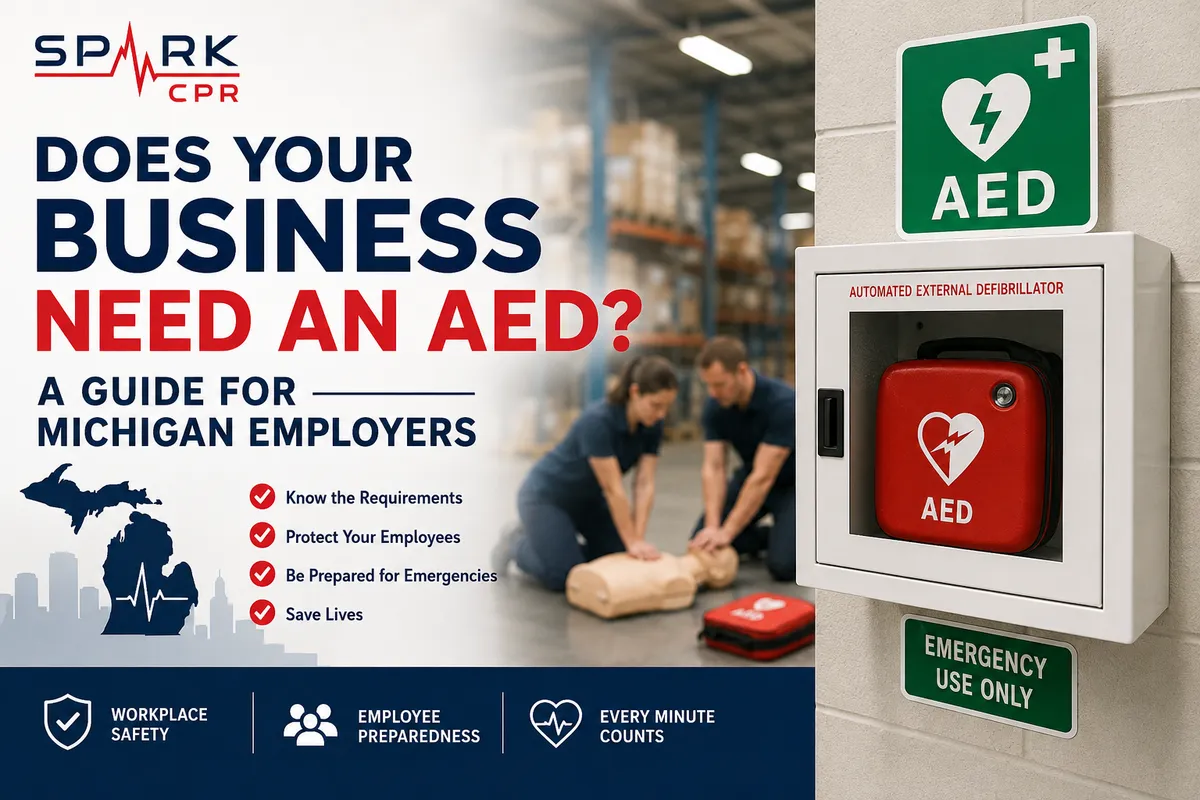
Does Your Business Need an AED? A Guide for Michigan Employers
Does Your Business Need an AED? A Guide for Michigan Employers
When business owners think about workplace safety, they usually think about fire extinguishers, first aid kits, emergency exits, and employee safety training.
An automated external defibrillator, or AED, may not be the first piece of emergency equipment that comes to mind.
But sudden cardiac arrest can happen almost anywhere—including offices, manufacturing facilities, warehouses, gyms, churches, restaurants, and other workplaces.
For Michigan employers, the question is often:
Does my business actually need an AED?
The answer depends partly on the type of business you operate. Some Michigan facilities are specifically required to have AEDs, while many other employers choose to install them as part of a broader workplace emergency preparedness program.
Here is what Michigan business owners should know.
This article is provided for general informational purposes and is not legal advice. Employers should verify requirements applicable to their specific industry and facility.
Are Michigan Businesses Required to Have an AED?
There is not a federal OSHA standard that specifically requires every workplace to have an AED.
OSHA does, however, recognize AEDs as an important workplace emergency-response tool and encourages employers to consider making them readily available. OSHA also provides guidance for businesses establishing workplace AED programs.
For many Michigan employers, installing an AED is therefore a workplace preparedness decision rather than a blanket requirement that applies to every business.
However, certain types of facilities have more specific requirements.
One of the clearest examples in Michigan is a qualifying health club.
Michigan Health Clubs Are Required to Have an AED
Michigan law specifically requires qualifying health clubs to maintain an AED on the premises.
Under Michigan's Medical Emergencies in Health Clubs Act, the owner or operator of a qualifying health club must:
Employ at least one individual who has completed approved basic First Aid, CPR, and AED training.
Have an AED available on the premises in a location that provides obvious and ready accessibility to staff, members, and guests.
Develop and implement an emergency plan addressing emergency medical services during operating hours.
The law defines a health club generally as an establishment whose primary purpose includes physical exercise, weight control, or figure development, including certain fitness centers, studios, and clubs.
There are exceptions within the statute, so business owners should review the law carefully when determining whether their facility qualifies.
For Michigan gyms and health clubs, an AED isn't simply an optional safety upgrade—it can be part of the facility's legal responsibilities.
SPARK CPR provides AED equipment for businesses and organizations and can also provide onsite CPR, AED, and First Aid training for employees.
What Does OSHA Say About AEDs in the Workplace?
OSHA does not specifically mandate AEDs across all workplaces, but its guidance strongly recognizes their value.
OSHA states that AEDs can play an important role in treating workplace cardiac arrest and has encouraged AED installation in workplaces.
Its workplace guidance also emphasizes one of the most important factors in AED placement:
Time.
An AED isn't very helpful if someone has to travel across a large facility, search for the device, unlock a room, and then return to the patient.
OSHA guidance recommends positioning workplace AEDs so they can be used within approximately three to five minutes after an emergency is reported.
That means businesses should think beyond the question:
“Do we own an AED?”
A better question is:
“Can someone actually get our AED to a patient quickly enough to make a difference?”
Why Should a Business Consider an AED Even If It Isn't Required?
Sudden cardiac arrest can occur without warning.
When cardiac arrest occurs, the person becomes unresponsive and is not breathing normally. CPR needs to begin immediately, and an AED should be retrieved as quickly as possible.
The American Heart Association reports approximately 10,000 cardiac arrests occur in workplaces annually and states that immediate CPR combined with AED use can double or even triple survival rates.
That makes AED ownership less about checking a compliance box and more about answering a practical question:
What resources will your employees have during the first few minutes of a cardiac arrest while EMS is responding?
Calling 911 is essential.
But employees and bystanders are the people already standing next to the patient.
Having an AED onsite gives them another critical tool while professional emergency responders are on the way.
Which Michigan Businesses Should Strongly Consider an AED?
Every workplace is different, but several factors can make an AED particularly valuable.
Businesses With Large Numbers of Employees
The more employees working at a location, the greater the number of people who could potentially experience a medical emergency.
Manufacturing facilities, warehouses, distribution centers, large offices, and other high-occupancy workplaces should consider whether an AED belongs in their emergency response program.
Businesses With Large Numbers of Customers or Visitors
Your emergency preparedness plan isn't only about employees.
Restaurants, churches, retail stores, community centers, event facilities, and other public-facing businesses may have hundreds or thousands of visitors throughout the year.
An AED may ultimately be used on a customer, contractor, visitor, or member of the public rather than an employee.
Large Buildings and Facilities
Square footage matters.
A single AED near the front office may not provide reasonable coverage for a large warehouse, manufacturing facility, multi-story office building, or sprawling campus.
The larger the facility, the more important AED placement becomes.
Workplaces Far From EMS Response
Businesses located farther from fire stations, ambulance services, or hospitals should carefully evaluate their emergency response capabilities.
An AED allows trained employees or bystanders to begin responding before EMS arrives.
Fitness and Physically Demanding Environments
Gyms and certain health clubs may already have specific Michigan requirements.
But other businesses involving significant physical exertion should also evaluate their risk.
That could include recreational facilities, sports organizations, industrial workplaces, construction-related operations, or jobs involving strenuous physical activity.
Workplaces With Electrical or Other Serious Hazards
OSHA's workplace AED guidance identifies several locations employers may want to consider when planning AED placement, including areas where many employees work closely together, locations near confined spaces, and areas involving electrically powered equipment.
An AED shouldn't replace other required safety equipment or procedures, but it can become another component of the facility's emergency response system.
How Quickly Should an AED Be Accessible?
When choosing AED locations, employers should think in terms of response time rather than convenience.
OSHA guidance recommends positioning AEDs so they can be used within approximately three to five minutes. The American Heart Association's workplace AED implementation guidance similarly emphasizes programs designed to get defibrillation to a cardiac-arrest patient within the first few minutes.
For a small office, one centrally located AED may provide reasonable access.
For a large manufacturing plant, warehouse, multi-building property, or multi-story workplace, it may not.
Businesses should physically walk their facility and ask:
How long does it take to reach the AED and return to the farthest point in the building?
Don't guess.
Walk it.
An AED mounted 30 seconds from the front desk could still be several minutes away from an employee working at the opposite end of a large warehouse.
Where Should a Workplace AED Be Located?
An AED should generally be placed somewhere that is:
Highly visible
Easily accessible
Clearly identified
Available during operating hours
Familiar to employees
Located along normal traffic routes
Positioned to minimize retrieval time
The AED shouldn't be hidden inside an office, locked inside a closet, or placed somewhere only management knows about.
Wall-mounted AED cabinets can help make devices highly visible and establish a consistent emergency equipment location.
Businesses with large facilities may need more than one device to achieve an appropriate response time.
What Should a Business Look for When Buying an AED?
Not every workplace needs the exact same AED.
When comparing devices, employers should consider more than the initial purchase price.
Important factors include:
Ease of use
Clear voice and visual instructions
Adult and pediatric capabilities
Electrode pad life
Battery life
Warranty coverage
Ongoing replacement costs
Durability
Automatic versus semi-automatic operation
Availability of replacement supplies
Long-term cost of ownership
SPARK CPR intentionally does not sell every AED available on the market.
We focus on AEDs we trust for businesses and organizations based on factors such as reliability, ease of use, long-term ownership, and real-world performance.
The best AED isn't simply the least expensive device.
It is the AED that fits your organization, remains properly maintained, and can be used confidently during an emergency.
Buying the AED Is Only the Beginning
Purchasing an AED doesn't automatically create an effective AED program.
Businesses also need a process for keeping that device ready.
AED ownership should include regular checks of items such as:
Device readiness indicator
Electrode pad expiration dates
Battery status
Cabinet accessibility
Signage
Emergency accessories
Inspection records
AED pads and batteries have limited service lives and must eventually be replaced.
SPARK CPR provides replacement AED electrode pads and AED batteries for the AED brands we support.
A device hanging on the wall for several years shouldn't automatically be assumed to be ready for use.
Someone within the organization should be responsible for checking it.
Should Employees Be Trained to Use the AED?
Modern AEDs are designed to guide a rescuer through the emergency with visual and/or voice prompts.
Training still matters.
During an actual cardiac arrest, employees aren't simply operating an AED.
They may need to:
Recognize cardiac arrest
Activate 911
Begin CPR
Direct another employee to retrieve the AED
Turn on and apply the AED
Follow the device's instructions
Continue CPR when directed
Coordinate the response until EMS arrives
Training allows employees to practice that entire sequence before they encounter it in a real emergency.
The American Heart Association Heartsaver First Aid CPR AED course is specifically designed for people with little or no medical training who need emergency-response skills for a workplace, regulatory requirement, or personal preparedness.
SPARK CPR provides American Heart Association CPR, AED, and First Aid training for businesses throughout Southeast Michigan.
For larger organizations, we can also bring the class directly to your facility through our onsite group training program.
Does Michigan Protect Someone Who Uses an AED?
Michigan law provides civil liability protections related to emergency AED use.
Michigan's Good Samaritan protections generally provide immunity for an individual rendering emergency services using an AED, except in circumstances involving gross negligence or willful and wanton misconduct.
The protections also extend in specified circumstances to individuals or entities that own, occupy, or manage the premises where the AED is located or used.
These protections are another reason businesses shouldn't assume that purchasing an AED creates an unreasonable expectation that every employee suddenly becomes a medical professional.
The AED is designed to assist the rescuer.
Training and a clear emergency plan help employees use that tool more confidently.
Workplace AED Readiness Checklist
Michigan employers considering an AED program can start with these eight questions:
Is our type of facility legally required to have an AED?
Review Michigan laws and industry-specific requirements that apply to your organization.How many employees and visitors are regularly onsite?
Consider everyone using the facility, not only full-time employees.How quickly can EMS reach our location?
Your employees will be the first people available to respond.Can an AED reach every part of the facility quickly?
Walk the building rather than estimating from a floor plan.Where should the AED be mounted?
Select a visible, accessible, clearly marked location.Who will check the AED?
Assign responsibility for monitoring readiness, pads, batteries, and accessories.Are employees trained in CPR and AED use?
Equipment becomes considerably more valuable when employees know how to respond.Do employees know the emergency plan?
Determine who calls 911, begins CPR, retrieves the AED, and directs EMS to the patient.
Does a Small Business Need an AED?
A small business may not be legally required to own an AED, but size alone shouldn't determine the decision.
Consider your location, number of employees, customer traffic, employee demographics, type of work, building layout, and EMS response time.
A small business with significant public traffic or a remote location may have a stronger reason for an AED than a larger organization located immediately next to emergency medical resources.
Evaluate the actual risk and response environment rather than using employee count alone.
Can Anyone Use an AED?
AEDs are designed to analyze a patient's heart rhythm and provide instructions to the rescuer.
The device determines whether a shock is appropriate.
That design makes modern AEDs usable by lay rescuers, but CPR and AED training can significantly improve an employee's confidence and ability to recognize the emergency, operate the device, and perform CPR effectively.
Training also gives employees the opportunity to practice their response before the pressure of a real cardiac arrest.
Do We Need CPR Training If We Already Have an AED?
An AED and CPR training should work together.
Someone experiencing cardiac arrest needs immediate action.
Employees should know how to recognize the emergency, call 911, begin CPR, retrieve the AED, apply it, and continue following the device's instructions until EMS arrives.
That's why businesses building an AED program should strongly consider incorporating CPR and AED training for their employees at the same time.
Build a Complete Workplace AED Program
The question isn't simply whether your Michigan business is legally required to have an AED.
The better question is:
If someone experiences sudden cardiac arrest inside your business tomorrow, what will your employees have available during the first few minutes?
An effective workplace response combines:
Trained Employees + Accessible AEDs + A Clear Emergency Plan
SPARK CPR is a firefighter-owned Michigan emergency preparedness and training company serving businesses, schools, churches, healthcare offices, manufacturing facilities, and other organizations throughout Monroe, Wayne, and Washtenaw counties.
We can help your organization select the right AED equipment for your workplace and provide onsite CPR, AED, and First Aid training for your employees.
Whether you're purchasing your first AED, adding coverage to a larger facility, or building a complete workplace emergency response program, the goal is simple:
Make sure your employees have the equipment, training, and confidence to respond when every minute matters.